POCUS and Diastolic Dysfunction

The Ultrasound Podcast was one of the first #FOAMed resouces that i regularly subscribed and listened to, and after completing some Notfallsonographie courses (which have now been integrated in the SGUM POCUS Curriculum) was a significant learning adjunct. The guys there have just produced two great videos (1 and 2) demonstrating a POCUS approach to Diastology and taking a focused looks at left atrial pressures and E/e’. Last month I also completed a day course on thorax ultrasound with the team from med-sono.ch, and there also heard an occasional reference to the possibility of using focused diastolic measurements My experience in the emergency department with tachydyspnoeic semi-supine patients has been very mixed when trying to achieve adequate apical windows, and getting high quality doppler waveforms is a further challenge.. although the urge to try quantify is almost irresistable...
In the back of my mind when watching these two videos and sitting during the course was niggling memory of this paper (open access pdf) published last month, with the reminder of the importance of "gain and filter adjustment, sufficient visualization of mitral annulus, absence of mitral annulus severe calcifications/prosthesis, correct angle (< 20°) of insolation, and adjustment according to the plane of cardiac motion". Never mind that "constrictive physiology, patients with moderate to severe primary MR and normal LV relaxation due to increased flow across the regurgitant valve, discordance between lateral and septal E’ in advanced systolic heart failure, atrial fibrillation, ventricular dys-synchrony or, moreover, regional wall motion abnormalities" can mess the TDI values..
The Ultrasound Gel podcast also had a look at two ultrasound based diagnostic strategies, one more focused on HF-rEF and one directed at HF-pEF:
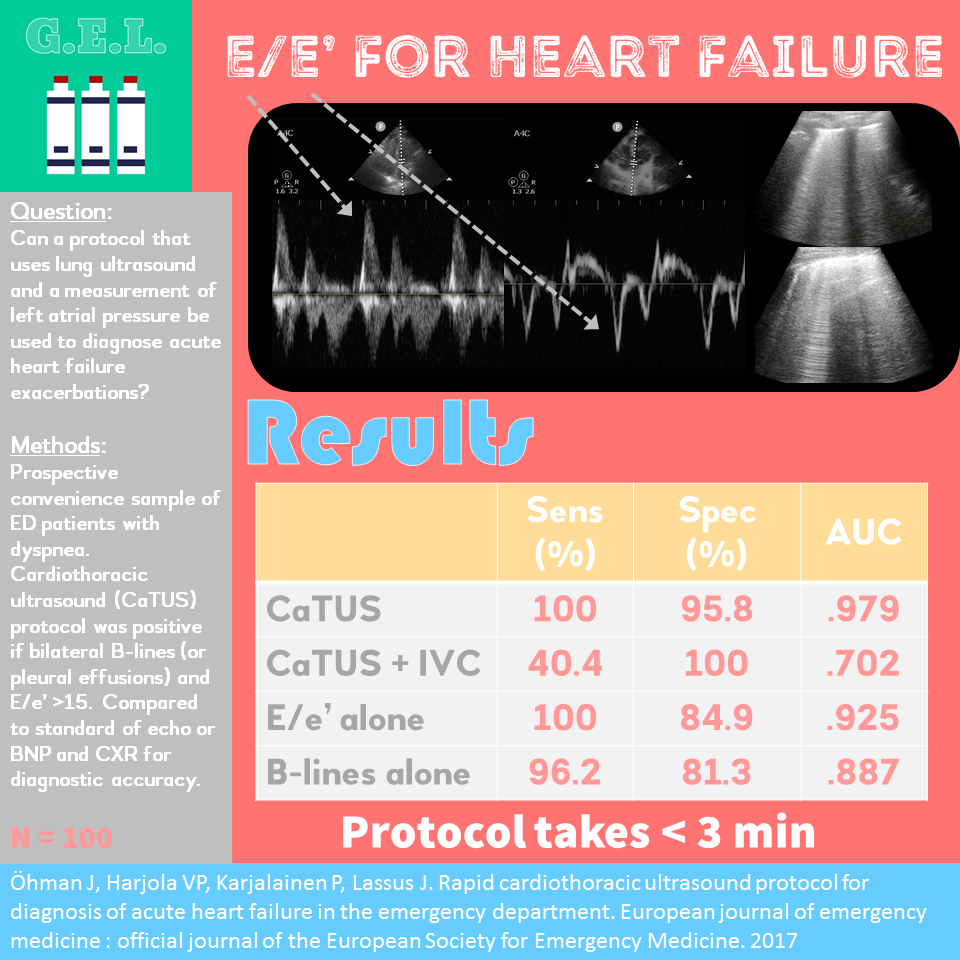
Both strategies get very nice positive likelihood ratios, but this if with highly experienced operators (in both studies >1000 previous examinations).
All of these aspects for me serve to reinforce of the strengths of a focused lung examination. The SIMEU team's paper (open access pdf) from a few years ago has flaws of its own (most significantly incorporation bias which may inflate the reported LR+ of 37.5 for the diagnosis of acute decompensated heart failure), but there was a diverse team of operators from multiple centres (starting after >40 scans).
Lung is certainly the low-hanging fruit of the POCUS examinations, and i think it's safe to say diastology is certainly several branches higher up...